Jomsom Muktinath Trek: A Complete Guide to Nepal’s Sacred Valley Route
10 Jul 2026 26 min to read

The guide presents the Jomsom Muktinath Trek as a 7–10 day route through Nepal’s Kali Gandaki valley, combining a dry, red-cliff landscape with villages, apple orchards, hot springs, and the sacred Muktinath temple at 3,800 meters. It outlines the trek’s appeal as a quieter alternative to more crowded Himalayan routes.
It also covers a day-by-day itinerary, seasonal advice, required permits, accommodation and food, and common mistakes such as starting late, underpacking, or skipping acclimatization. Practical guidance emphasizes early starts, cash, and preparation for wind and dust.
Why the Jomsom Muktinath Trek Deserves Its Own Spot on Your Nepal Itinerary
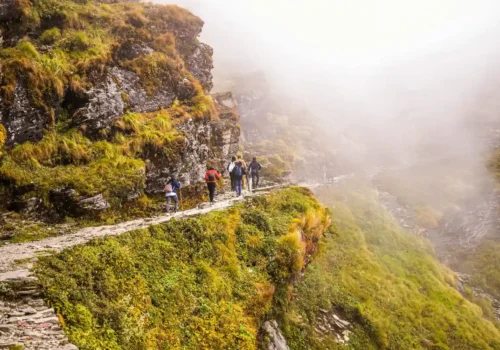
You’ve seen photos of Nepal’s green hills and tall snowy mountains. But there’s another side of this country. The Jomsom Muktinath trek takes you into a landscape most travelers don’t expect in Nepal. The trek goes through a rain shadow desert of red cliffs, windswept canyons, and ancient villages that feel frozen in time.
This trek winds through the lower Annapurna region before ascending the Kali Gandaki valley to the sacred Muktinath temple at 3,800 m. Along the way, you’ll pass through Ghorepani (famous for sunrise over Dhaulagiri), Tatopani (natural hot springs), Marpha (Nepal’s apple capital), and Jomsom (the valley’s main town).
We’ve guided trekkers through this route for years, and with the experience, we can tell you what awaits. Beautiful red sandstone cliffs that look uncannily like Utah, apple orchards that produce the best pie you’ll eat in Nepal. And the main highlight is the ancient temple of Muktinath, a mecca for Hindus and Buddhists, boasting 108 water spouts and an eternal flame.
In this guide, we’ll cover everything one would need to know, starting from the popular trek route from Pokhara, required permits, optimal season for trekking, as well as the errors we’ve seen trekkers consistently make on this trail.
Let’s plan your trek.
What is the Jomsom Muktinath Trek?
A route that takes you to the beautiful valley of Kali Gandaki, usually from Pokhara to the Muktinath temple on the Annapurna massif at 3,800m. The Jomsom Muktinath trek usually lasts 7-10 days and takes you from the rain shadow desert through breathtaking red rock canyons and traditional walled villages to the ancient holy Muktinath.
It is an alternative to the more popular Annapurna Circuit and Everest Base Camp treks and offers a much less crowded and more culturally diverse experience through a landscape is unlike anything else in the Himalayas.

What Makes This Trek Unique?
There are hundreds of different options for trekking destinations in Nepal. Each and every one of them is unique in its own way. Jomsom Muktinath trek also has its own attractive features that set it apart from other popular treks like EBC and ABC.
- The Landscape
This region lies in the Kali Gandaki valley, nestled between the Annapurna and Dhaulagiri massifs, making this a rain shadow area (i.e. it gets almost no rain). You’ll get to see a very different landscape from other parts of Nepal; red & brown cliffs, reminiscent of Utah or Arizona.
- Muktinath Temple
The Muktinath temple stands at an elevation of 3,800m and is important for Hindus and Buddhists. Hindus know it as “Mukti Kshetra” (the place of liberation), while Buddhists revere it as a sacred site of Guru Rinpoche.
- Apple Orchards and Local Life
You’ll also travel through the Marpha village, famed as Nepal’s “apple capital”. The orchards, apple brandy distilleries, and pies here are so good, this alone is worth the entire trek.
- Natural Hot Springs at Tatopani
The hot natural hot spring at Tatopani (literally “hot water” in Nepali) lets you enjoy a relaxing time at the serene environment with the beautiful view of mountains at sunset.
Who is This Trek For?
While anyone can do this trek, it is extra enjoyable for certain types of travelers.
- Culture lovers: This trek attracts pilgrims from various regions, and those who are looking to enjoy the distinct culture of the traditional village and their local way of living.
- Trekkers seeking solitude: Because it’s not as popular as other treks like ABC or Circuit treks, people who like quieter trails without the crowds will absolutely enjoy this.
- Moderate pie enthusiasts: Marpha alone is worth the walk.
- Those short on time: This trek usually lasts 7-10 days, but still succeeds in giving you a meaningful experience.
Who should skip it?
Although most would love this trek, if you’re someone seeking extreme altitude, go to Everest or Island Peak. If lush forests are what you seek, then choose ABC or Langtang. Also this region is slightly more expensive due to its remoteness so it might be difficult if you’re on a tight budget.
A Note from the Trail
After guiding trekkers through this route for years, we can say that the Jomsom Muktinath trek is one of Nepal’s hidden gems. It just doesn’t have the fame of Everest nor the crowds of the Circuit. But it has something both lack: a landscape that looks like nothing else, a culture that feels authentic, quiet moments that feel special.
That’s not advertising talk. That’s what the trail has taught us.
Why Choose the Jomsom Muktinath Trek?
If you’re unsure whether you want to go on this trek or not, we have listed some of the practical and logical qualities that makes Jomsom Muktinath trek quite attractive to travelers.
- Moderate difficulty without sacrificing views
The maximum elevation this trek reaches is 3,800m which is relatively lower than that of other popular treks, making AMS risk lower here. Also, there is no high passes in this trek so, even someone with moderate fitness or no prior trekking experience can complete this trek. But even with less altitude, the views seen are no less beautiful than other treks, making this a worthy adventure.
- Shorter duration
This trek is perfect for those who have limited vacation time due to its shorter duration. Or this can also be added as a detour to another larger Nepal itinerary, which is actually preferred by many. It requires less commitment than other longer treks do.
- Quieter trails
This region being less popular, invites fewer crowds than other treks like EBC. This means you can actually enjoy a peaceful trek in genuine solitude without being completely remote.
- Flexible itinerary
This trek can be customized easily according to your requirements. It can be shortened or extended by adding Khopra Danda, Mohare Hill, or even adding this as a detour to Annapurna Circuit.
- Value for money
Even though this trek is remote, costing a bit more, its shorter duration eventually means lower overall cost. Despite being less commercialized, you’ll find good teahouse infrastructure throughout the trek. This trek is definitely worth every penny.
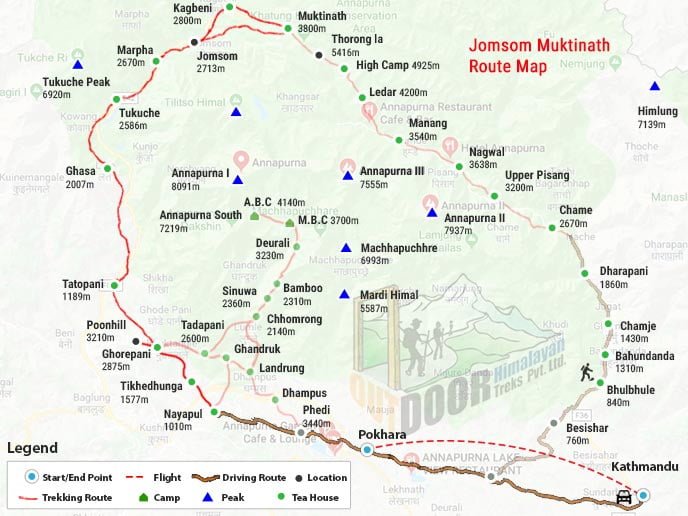
The Classic Jomsom Muktinath Trek Route
This is the route we know best, the one we’ve guided more times than we can count. It’s a 12-day journey that takes you from the lakeside city of Pokhara through rhododendron forests, traditional Thakali villages, the apple orchards of Marpha, and finally to the sacred Muktinath villages at 3,800m. Just so you can imagine what the trekking days will actually be like, we have written a detailed day-by-day itinerary of the Jomsom Muktinath trek:
Day 01: Arrival in Kathmandu (1,400m)
Your Nepal adventure begins the moment you land. We’ll meet you at the airport and transfer you to the hotel. Rest, explore Thamel, or simply prepare for the journey ahead.
Day 02: Kathmandu to Pokhara (820m)
The second day starts with a 6-7 hour scenic drive to Pokhara which is considered the gateway to the Annapurnas. You’ll get views of beautiful terraced hills along the Trishuli River. But if this feels tiring, or you’re short on time, there is also a 25-minute flight option that offers equally stunning Himalayan views from the window.
Day 03: Pokhara to Tikhedhunga (1,540m)
This day marks the start of your trek with a 2-hour drive to Nayapul. You begin a gentle trek on the trail following the Modi Khola through lush forests and terraced farmlands. You’ll cross suspension bridges, pass small villages, and climb gradually to Tikhedhunga.
Walking time: 3-4 hours, Altitude gain: +720m
Day 04: Tikhedhunga to Ghorepani (2,874m)
This day includes an ascending trail through the famous Ulleri steps, which has over 3,000 stone steps. It will test you but it’ll all be worth it when you reach Ghorepani, a mountain village perched on a ridge with views of Dhaulagiri and Annapurna South.
Walking time: 5-6 hours, Altitude gain: +1,334m
Day 05: Ghorepani to Poon Hill (3,210m) to Tatopani (1,190m)
You’ll trek to Poon Hill before sunrise. It is the most popular viewpoint in the Annapurna region. Watching the sun hit Dhaulagiri (8,167m), Annapurna I (8,091m), and Machhapuchhare (6,993m) from here is a magical experience worth the 4 AM wake-up call.
After breakfast, you’ll descend through rhododendron forests to Tatopani, a village famous for its natural hot springs.
Walking time: 6-7 hours, Altitude loss: -2,020m
Day 06: Tatopani to Ghasa (2,007m)
The trail follows the Kali Gandaki River north, entering the rain shadow. You’ll see the landscape starting to change, from green forests to drier, more open terrain. You’ll be passing through the village of Dana and cross the world’s deepest gorge- the Kali Gandaki, sandwiched between Annapurna and Dhaulagiri.
Walking time: 5-6 hours, Altitude gain: +817m
Day 07: Ghasa to Marpha (2,670m)
This is a relatively easy day as it includes a gradual climb to the apple orchards. Passing through the traditional Thakali village of Tukuche, you’ll arrive at Marpha, Nepal’s apple capital. It’s famous for its apple orchards, apple brandy and the best apple pie you’ll eat on any trek.
Walking time: 4-5 hours, Altitude gain: +663m
Day 08: Marpha to Kagbeni (2,810m)
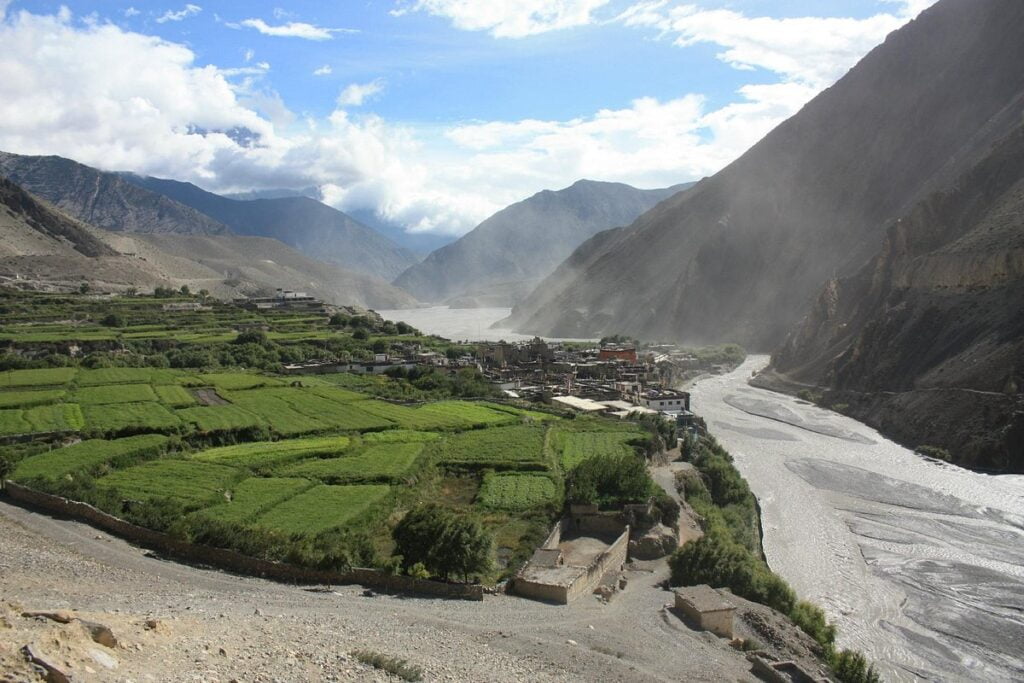
Walking beside the Kali Gandaki River, you’ll pass through the villages of Jomsom (the district headquarters) and Eklebhatti before arriving at Kagbeni. This village sits at the confluence of two rivers and marks the boundary between the lower and upper Mustang regions.
Walking time: 4-5 hours, Altitude gain: +140m
Day 09: Kagbeni to Muktinath (3,800m)
This day marks the final ascent. Leaving Kagbeni, you’ll follow the Jhong Khola valley through a dramatic canyon. You’ll finally reach the destination, Muktinath, featuring 108 water spouts, two sacred ponds, and an eternal flame. You’ll have the evening to explore.
Walking time: 5-6 hours, Altitude gain: +990m
Day 10: Muktinath to Jomsom (2,720m)
After a final morning visit to the temple, you’ll walk from Muktinath to Jomsom, the main town of the region. The trail winds downward through Kagbeni and along the Kali Gandaki River. If you’re tired, you can take a shared jeep from Kagbeni.
Walking time: 5-6 hours, Altitude loss: -1,080m
Day 11: Jomsom to Pokhara
If the weather is right, you’ll take a morning flight back to Pokhara, watching the aerial views of the mountains you’ve just walked through. But if the weather doesn’t cooperate, you can drive instead (about 8-9 hours).
Day 12: Pokhara to Kathmandu
The journey ends with a final drive or flight back to Kathmandu. We’ll transfer you to your hotel, or airport depending upon your next step.
A Note about Walking Times
The times above are average estimates based on our experience guiding trekkers of moderate fitness. Your actual time will vary depending on:
- Your pace
- Photo stops
- Tea breaks
- Weather conditions
Our guides always build in extra time for the unexpected; a chat with a local, a view that demands a long pause, or simply a moment to catch your breath.
What about Customization?
The itinerary above is our standard route. But your Nepal trek doesn’t have to be one-size-fits-all.
We can adjust the duration, add rest days, or even combine this trek with other experiences, like a cultural tour of Kathmandu Valley or a wildlife safari in Chitwan.
Just ask us. We’ll build it around you.
Best Time for Jomsom Muktinath Trek
There is a time to go anywhere that gives you the best experience. Jomsom Muktinath trek is doable year-round. But even for this, not all seasons are equal. Here is the comprehensive analysis of all the seasons and how they affect your trek to Jomsom Muktinath.
Autumn (October – November): The Best Season
This is the ideal season for trekking to most of the destinations in Nepal, including the Jomsom Muktinath trek. With clear skies and stable weather, the views you get are wonderful. Mountains like Dhaulagiri and Annapurna become visible from every ridge. Warm days and cool nights make the trek actually pleasant. In this season, the air is crisp and the dust settles, which only adds to the advantage of trekking in autumn.
The only downside of this season is the crowd. Because of these advantages, most people prefer to visit during this time, making the teahouses busy. We advise you to book in advance if you want to trek in autumn.
Spring (March – April): Second Best
Spring is also a popular season for the Jomsom Muktinath trek. You’ll be able to get stunning views of rhododendrons blooming on lower sections. Also the apple orchards start flowering in spring doubling the beauty of Marpha. The days will be warmer than autumn, which many trekkers might prefer. Although it’ll be slightly dustier, trekking during this time has its own benefits.
The downside of this season has to be dust. The valley is already dry and when the wind kicks it up, it can get hazy later in the day.
Winter (December – February): For Experienced Trekkers Only
We would only recommend you trek in winter if you are experienced. It’s not impossible but there are a lot of challenges in this season. First challenge is temperature. Muktinath temperatures drop to -10oC at night, which is already difficult for most. Plus, afternoon wind gets relentless, strong enough to knock you off balance in winter. Because of these reasons, some teahouses even close during this time. There is also the problem of flight cancellation from Jomsom to Pokhara frequently.
Although this is possible with proper gear and preparation, we do not recommend this for first-timers.
Summer/Monsoon (June – September): Avoid
Jomsom lies in a rain shadow area, so it doesn’t really get much rain like other regions. So trekking here during summer is absolutely possible. But the trail is slippery and landslides can block roads. Flights can also be cancelled regularly. Due to lower sections still getting rain, leeches become a very big problem there. Also you might not be able to get the best views with clouds blocking the mountains.
Overall, it is unpredictable and not worth the risk for first-timers.
What to Expect on the Trail
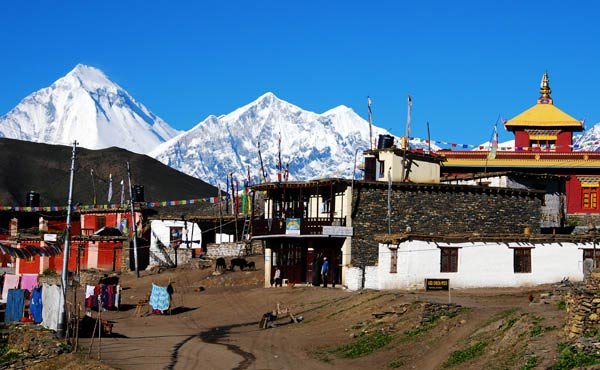
Daily life on the Jomsom Muktinath Trek is much simpler than you might expect, and far more rewarding. You wake up early every day, walk through ever-changing landscapes, share meals with fellow trekkers. You sleep in teahouses. It’s a routine that becomes normal, as you get used to it. By the end of this trek you’ll already miss it.
Here’s what that daily rhythm feels like.
The Wind (Start Early, Finish by Lunch)
This is the most crucial information on the Jomsom Muktinath Trek.
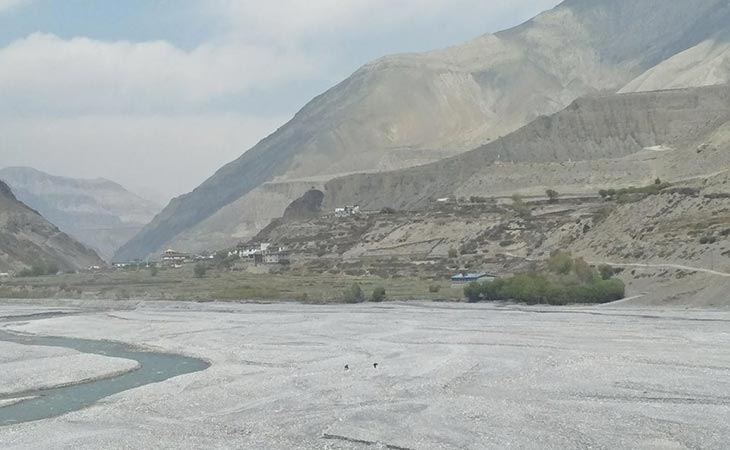
The deep valley of the Kali Gandaki River is located in the rain shadow of two of the highest mountain peaks in the world, named Dhaulagiri (8,176m) and Annapurna (8,091m). The wind blows through this narrow gorge with a great force, picking up speed as the day warms.
What to expect: The winds start to pick up speed on a daily basis especially by 1-2 PM, when they reach their maximum force of 40-50 km/hr. This wind is strong enough to kick up dust slow your pace, and test your patience.
How to handle it:
- Start your walking day by 6-7 AM
- Aim to finish by lunch (1 PM)
- Wear wraparound sunglasses (dust protection)
- Bring a buff or bandana for your mouth and nose
Trekkers who have followed this have rarely complained about the wind as they’re already prepared for it.
The Landscape (Two Treks in One)
The Jomsom Muktinath trek differs from most other trekking holidays in Nepal in that it offers a contrast of two very different ecosystems.
The lower section (Days 1-5): Lush green hills, terraced rice fields, and rhododendron forests that explode with color in spring. This feels like classic Nepal, the one you actually see in postcards.
The upper section (Day 6-10): A rain shadow desert. Red cliffs, brown canyons, and a landscape that feels more like Utah than the Himalayas. The contrast is striking, and it’s what makes this trek unforgettable.
Most trekkers tell me they feel like they’ve done two treks in one. And they’re right.
Teahouses (Basic but Welcoming)
This, being a fairly remote trek, offers simple accommodation along the route. Luxury is not the point here.
Here’s what you’ll find:
- Rooms: twin beds with thin pillows and blankets (extra blankets available)
- Bathrooms: shared, with squat toilets (some have Western-style)
- Hot showers: available for a small fee (often $2-3 USD)
- Wi-Fi: limited or non-existent (embrace the disconnection)
- Charging: available for a fee (bring a power bank)
What you won’t find:
- Room service
- In-room bathrooms (except in Marpha and Jomsom)
- Central heating
My honest advice: The teahouses are run by warm, hardworking families who show wonderful hospitality. A little respect goes a long way.
The Food (Dal Bhat, Momo, and Apple Pie)
The food you’ll find on this trek isn’t luxurious or with many options. They are simple but nourishing, providing ample energy for the trek.
Here are some of the most common foods you’ll find on this trek:
- Dal Bhat: rice, lentil soup, vegetables, and pickles. Filling, healthy, and everyday food for most Nepalis.
- Momo: steamed dumplings. Tasty and a welcome treat after a long day.
- Noodles: safe, comforting, and available everywhere.
- Thakali khana set: a Thakali speciality with extra flavors.
The highlight: Marpha’s apple pie
Marpha is Nepal’s “apple capital” and for the right reason. The orchards here produce the best apples in the country. And the teahouses have perfected the art of apple pie. Warm, flaky, spiced and served with custard or cream.
The People (Warmth and Pilgrims)
The Jomsom Muktinath trek passes through Thakali and Tibetan Buddhist communities. You’ll notice:
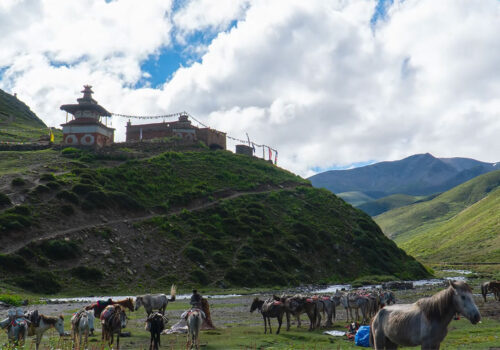
- Prayer flags strung across cliffs and village entrances
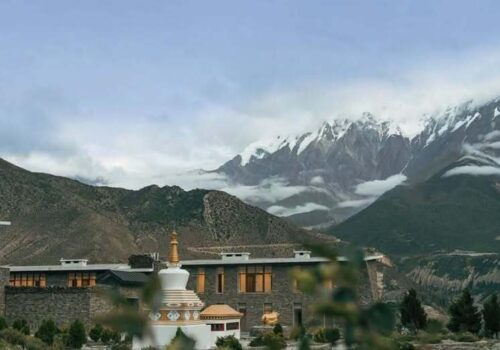
- Chortens (Buddhist shrines) at every turn
- Thakali hospitality; genuine, generous, and memorable
- Pilgrims from India and Nepal heading to Muktinath, adding a spiritual layer to the trail
In Kagbeni, an ancient walled village that feels frozen in time, you’ll walk alleys unchanged for centuries. The vibrancy of the prayer flags against the mud-brick walls is something photos can’t capture.
Many locals are devout. Ask before taking photos of people or inside temples. A small smile and a gesture to your camera is sometimes enough.
The Muktinath Temple (Sacred and Stirring)
Reaching Muktinath at 3,800m is the emotional high point of the trek.
What you’ll experience:
- 108 water spouts: shaped like cow heads, you’ll see pilgrims walking under them, even shivering in the cold water. They believe the holy water purifies them.
- Two sacred ponds: believed to have cleansing properties
- An eternal flame: natural gas burning from the ground
- Hindu and Buddhist pilgrims: chanting, praying, and creating an atmosphere that’s both festive and reverent
My advice: Arrive in the late afternoon. Visit the temple at sunset when the crowds thin. Return at sunrise when the light hits the white temple walls. You’ll understand why people walk weeks to reach this place.
The Ulleri Steps
No trek is without difficulties. The Ulleri steps (Day 4) hasover 3,000 stone steps carved into the hillside. This part may make you regret the trek but trust us. Take it slow, one step at a time, and you’ll realize the views are worth every step.
What Trekkers Tell Us (A Note from the Trail)
Every single group that we’ve guided says the same thing: “I didn’t expect this landscape. It’s like Nepal meets the American Southwest.”
And they’re not lying! The red rocks, the canyons, the wind-swept villages are all a pleasant surprise.
The Jomsom Muktinath trek may not be known for its difficulty or extreme altitude, but it is known for its variety and that’s something worth noting.
Permits You’ll Need for the Jomsom Muktinath Trek
Like most of the treks in Nepal, the Jomsom Muktinath trek also requires certain permits for you to enter the area. The permits are required to protect not only the trekkers but also this region.
The Jomsom Muktinath trek falls within the Annapurna Conservation Area, so two permits are required: the Annapurna Conservation Area Permit (ACAP) and the TIMS card. Neither is complicated to get. And if you’re booking through us, we handle everything for you.
Here’s what you need to know.
Annapurna Conservation Area Permit (ACAP)
The permit is mandatory for anyone entering the Annapurna region, whether you’re trekking, driving, or even flying in.
Cost of ACAP:
| Nationality | Cost (NPR) |
| Foreign nationals (non-SAARC) | NPR 3,000 |
| SAARC nationals (India, Bangladesh, etc.) | NPR 1,000 |
| Nepali citizens | Free |
Where to get it:
- Kathmandu: Nepal Tourism Board office (Bhrikuti Mandap) or NTNC office
- Pokhara: NTNC office near Lakeside or Nepal Tourism Board office
- Online: https://epermit.ntnc.org.np/
Important: Buying your permit in Kathmandu or Pokhara costs NPR 3,000. If you wait until the checkpoints along the trail, it’s NPR 6,000. Don’t make that mistake.
TIMS Card (Trekkers’ Information Management System)
The TIMS card is a government requirement for all independent trekkers in Nepal. It’s designed for safety; in case of emergencies, authorities know who is on the trail.
Cost TIMS:
| Nationality | Cost (NPR) |
| Foreign nationals | NPR 1,000 |
| SAARC nationals | NPR 300 |
Where to get it:
- Same offices as ACAP (Kathmandu or Pokhara)
- Also available through registered trekking agencies
Note: If you’re booking through a registered agency, we’ll obtain the TIMS card on your behalf. You won’t need to visit any office yourself.
Important Distinction: Lower Mustang vs Upper Mustang
This is where travelers get confused. Let’s clear it up.
The Jomsom Muktinath trek covers Lower Mustang. So you will not need the Restricted Area Permit unless you’re continuing into Upper Mustang.
But if you’re interested in Upper Mustang as well, we can arrange that too. But it’s a separate trek with different logistics, costs, and time requirements.
What You’ll Need to Get Permits
If you’re getting the permits by yourself, these are the important requirements:
- Passport copy (not original)
- 2 passport-sized photos (for TIMS card)
- Cash in NPR (permits are not card-friendly)
Pro tip from the trail: Get your permits in Pokhara. The NTNC office is efficient, the queues are short, and you can do it on the same day you arrive. One less thing to worry about before you start walking.
Booking Through Us
If you’re booking the Jomsom Muktinath trek through us, we handle everything:
- ACAP permit
- TIMS card
- All paperwork
- Teahouse bookings
- Guide and porter arrangements
You don’t need to visit any office. Just arrive with the requirements and we’ll have everything ready.
Common Mistakes on This Route
After guiding trekkers through this route for years, we’ve seen the same mistakes play out again and again. Most are avoidable. A little preparation goes a long way.
Here are some of the most common mistakes and how to sidestep them.
Mistake 1: Starting Your Walking Day Too Late
This is the biggest mistake on the Jomsom Muktinath trek. The Kali Gandaki valley is famous for its afternoon wind. By 1-2 PM, the wind gets strong enough to kick up dust, slow your pace and drain your energy.
How to avoid it: Start walking by 6-7 AM. Finish by lunch. You’ll enjoy the trail more, take better photos, and arrive at teahouses before the crowds.
Mistake 2: Underestimating the Ulleri Steps
Day 4 of this trek involves over 3,000 stone steps. Don’t underestimate it and rush in the beginning. It’s tough (hence, we repeat this) but not impossible.
How to avoid it: Take it slow. One step at a time. Rest when you need to. Hydrate regularly and remind yourself that the sunrise from Poon Hill the next morning is worth it.
Mistake 3: Rushing Muktinath
Most trekkers arrive at Muktinath in the afternoon, visit the temple for an hour, and leave the next morning. They see the temple once, in a bad light, with crowds.
How to avoid it: Visit the temple at sunset when the crowds thin. Return at sunrise when the light hits the white temple walls.
Mistake 4: Skipping Kagbeni
Many trekkers take a jeep directly from Muktinath to Jomsom, bypassing Kagbeni entirely. This leads to them missing the most atmospheric village on the entire route, Kagbeni.
How to avoid it: Walk from Muktinath to Kagbeni. Spend a night there. Explore the alleys and enjoy the peaceful settings of the monastery.
Mistake 5: Not Carrying Enough Cash
ATMs exist in Jomsom and Pokhara. But you won’t find it anywhere on the trail. Everything, from teahouses, snacks, hot showers, charging phones, all require cash. And if you run out, there is no backup.
How to avoid it: Carry enough Nepali rupees for the entire trek. A good rule of thumb: 3,000-5,000 NPR per day for food, accommodation, and incidentals. And keep some emergency cash hidden in your bag.
Mistake 6: Forgetting a Power Bank
Teahouses charge for phone and camera charging. And outlets are limited. If you’re relying on your phone for photos, navigation, or music, you’ll want backup power.
How to avoid it: Bring a power bank with enough capacity for 4-5 days. You won’t always have access to electricity. Especially in more remote teahouses.
Mistake 7: Ignoring Acclimatization
Even though the Jomsom Muktinath trek doesn’t go as high as the Annapurna Circuit or Everest Base Camp, Muktinath still sits at 3,800m. This is high enough for altitude symptoms, especially if you rush.
How to avoid it: Take it slow. Stay hydrated. Eat well. And listen to your body. If you feel a headache or nausea, rest. Don’t push through it.
Mistake 8: Overpacking
You’ll see trekkers struggling with 20kg backpacks on the Ulleri steps. Don’t be that person.
How to avoid it: Pack for one week. Do laundry along the way. Leave the heavy items in Pokhara. Your knees, and your guide will thank you.
Mistake 9: Not Booking Teahouses in Peak Season
In October-November and March-April, teahouses fill up quickly. If you arrive late in the afternoon, you might end up in a dormitory or without a room.
How to avoid it: Book through an agency (like us!) or ask your guide to call ahead. If you’re going independently, arrive early, and consider booking your first few nights in advance.
Honest Advice from the Trail
The Jomsom Muktinath trek isn’t technically challenging, but it does require preparation, both mental and physical. The wind, the dust, the stairs all test your patience more than your fitness.
We’ve led many groups on this trek and they have made at least one of these mistakes. The ones who planned ahead suffered less during the trip and got more out of the experience. But the ones who didn’t also still enjoyed their time on the trail, with a few extra stories to tell.
Frequently Asked Questions
How long does the Jomsom Muktinath trek take?
Typically, 7-10 days, depending on your route and pace. The classic itinerary from Pokhara via Nayapul takes about 10 days. A shorter version using a flight to Jomsom can be done in 5-7 days.
What’s the best time to go to Jomsom Muktinath?
Autumn (September – November) and spring (March – May) offer the clearest skies and most stable weather. Winter is possible but freezing at Muktinath. Monsoon (June – August) brings rain to lower sections, though the upper valley stays relatively dry due to the rain shadow.
How far is Jomsom to Muktinath?
The distance from Jomsom to Muktinath is approximately 16 km by road. The trekking route is slightly longer at around 18-20 km, depending on the path you take.
How long does it take to trek from Jomsom to Muktinath?
Most trekkers complete the Jomsom to Muktinath trek in 2 days:
- Day 1: Jomsom to Kagbeni (~10km, 3-4 hours)
- Day 2: Kagbeni to Muktinath (~11-13 km, 5-6 hours)
If you’re fit and start early, you can push through in one long day, but the afternoon wind makes this unpleasant. Two days is the smarter choice.
How difficult is the Jomsom Muktinath trek?
Moderate. The highest point is Muktinath at 3,800m; lower than Everest Base Camp or Thorong La. The main challenges are the Ulleri steps (3,000+ stone steps) and the afternoon wind in the Kali Gandaki valley.
What permits do I need for Jomsom Muktinath trek?
Two permits: Annapurna Conservation Area Permit (ACAP) and TIMS card (Trekkers’ Information Management System). ACAP costs about NPR 3,000 for foreigners. TIMS is around NPR 1,000. Buy them in Kathmandu or Pokhara; checkpoints charge double so avoid that.
Is altitude sickness a concern during the Jomsom Muktinath trek?
Yes, but less so than on higher treks. Muktinath sits at 3,800m and some trekkers feel mild symptoms. Acclimatize properly, hydrate well, and ascend slowly. If you fly directly to Jomsom (2,720m), spend a night there before going higher.
What’s the accommodation like in Jomsom Muktinath trek?
Basic teahouses and lodges with simple rooms, shared bathrooms, and common dining areas. Hot showers cost extra (usually $2-3). Wi-Fi is limited or non-existent. Embrace the simplicity.
Can I do Jomsom Muktinath trek without a guide?
The trail is well-marked and many trekkers go independently. However, a guide adds cultural context handles logistics, and provides safety support. If you’re a first-timer, a guide is worth the investment.
Can I drive from Jomsom to Muktinath instead of trekking?
Yes. The road is complete and shared jeeps make the journey in under an hour. If you’re short on time or prefer not to walk, we can arrange transport. However, trekking allows you to experience the valley (the villages, the orchards, the charging landscape) in a way that driving simply doesn’t offer.
Ready to Add Jomsom Muktinath to Your Trek?
You’ve got the route, the permits, challenges, and honest advice. Now it’s up to you.
The red cliffs of the Kali Gandaki, the apple orchards of Marpha and the sacred waters of Muktinath at sunrise. This trek is less intense than the typical trail, is more cultural, and offers surprising highlights.
If this is the adventure for you, we’re here to make it happen.
We’ll handle the permits, teahouses, guide, and logistics. You just show up and walk.
Your Final Checklist
- Passport (6+ months validity)
- ACAP + TIMS permits (or let us arrange them)
- Enough NPR cash for teahouses
- Windproof jacket + sunglasses + power bank
- Moderate fitness + patience for the wind
Ready to book? Browse our Jomsom Muktinath trek package.
Still deciding? Ask us anything– we’ll answer every question.
Updated On: 11 Aug 2026