Altitude Sickness in Nepal: Symptoms, Prevention & Treatment
23 Aug 2026 20 min to read

Any major trek in Nepal like Everest Base Camp Trek, Annapurna Circuit Trek, Manaslu Trek, Langtang Valley Trek, Kanchenjunga takes you to an altitude where your body has difficulty in obtaining sufficient oxygen. Altitude sickness in Nepal is not a very uncommon problem or one that only occurs due to bad luck. In fact, altitude sickness is a natural physiological reaction to gaining altitude rapidly, and knowing all about it would be the best preparation that one can make for a Himalayan trek.
This guide addresses what altitude sickness truly is, how it can be identified, how it can be avoided, which individuals are more likely to be affected, and, most importantly, exactly what happens if an individual suffers from altitude sickness including how the evacuation process actually works on the trekking path.
Quick Summary: Altitude sickness (AMS) is a natural consequence of hiking faster than 2,500 meters, no matter the individual’s physical condition. The basic guidelines for the prevention of the illness include the ascent process should not exceed 300-500m per day starting from 3,000m, drinking enough water and descending immediately if there are any severe symptoms (HAPE/HACE).
The information provided is generally for educational purposes and not meant as a substitute for medical consultation. Make sure you visit your physician or an altitude specialist prior to a high-altitude trek.
What Altitude Sickness Actually Is
At altitudes above about 2,500 meters, the pressure is lower, which means each breath you take contains less oxygen. There needs to be time for your body to adjust — by making more red blood cells, by breathing faster, and altering the heart rate. Altitude sickness occurs if you rise faster than your body can make these adjustments.
Fitness has no role to play. Marathon athletes have altitude sickness. Sixty-year-old couch potatoes who go hiking might not have any problems at all. The greatest risk factor is not fitness, but ascent rate. Often, very fit people are at greater risk, simply because they are so fit that they can ascend much faster than their bodies can acclimatize.
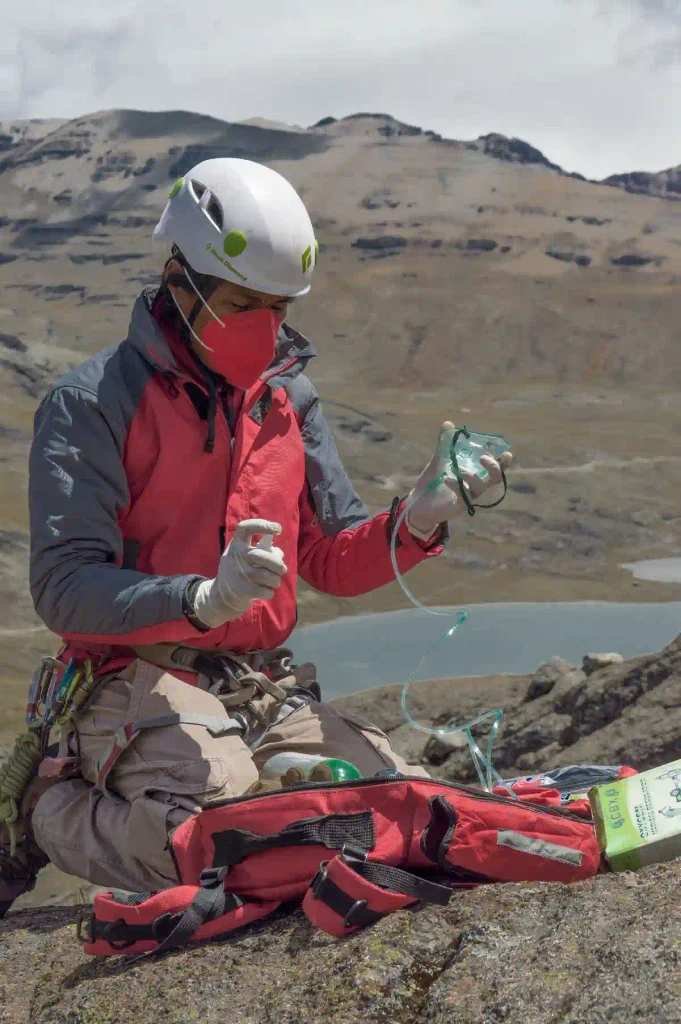
There are three types of altitude sickness in related sequence of importance:
1. Acute Mountain Sickness (AMS)
The common, usually mild form. Symptoms typically appear 4–8 hours after arriving at a new altitude and include:
- Headache (this is the defining symptom — AMS is not diagnosed without one)
- Nausea or loss of appetite
- Fatigue and weakness
- Dizziness or lightheadedness
- Trouble sleeping
Mild AMS is extremely common on Nepal’s classic routes — many trekkers experience some version of it around 3,500–4,500m and recover with rest and a slower pace. It only becomes dangerous if ignored and pushed through.
A note on sleep: Disturbed sleep and a pattern of pausing breathing at night (called periodic or Cheyne-Stokes breathing) are extremely common above 4,000m on their own and don’t count as AMS unless accompanied by headache and other symptoms above. Don’t panic over a rough night’s sleep alone — but don’t ignore it if it comes with a headache, either.
2. High Altitude Pulmonary Edema (HAPE)
Excess fluid fills the lungs. It is very dangerous and could be fatal in a few hours if not treated. Early warning signs include:
Difficulty breathing at rest (and not just when exercising)
Cough with frothy or bloody discharge
Fatigue that is much more than normal
Shortness of breath
A bluish or grey coloration around the lips and fingers (sign of low oxygen levels)
3. High Altitude Cerebral Edema (HACE)
Swelling in the brain. Also potentially fatal within hours. Warning signs:
- Severe headache that doesn’t respond to painkillers
- Confusion or altered mental state
- Loss of coordination — the standard field test is trying to walk heel-to-toe in a straight line and being unable to
- Drowsiness progressing toward unconsciousness
The rule that matters most: if someone develops HAPE or HACE symptoms, the only reliable treatment is immediate descent. Not “descend tomorrow” — immediate. Every hour at altitude makes it worse.
When and Where Altitude Sickness Can Happen in Nepal
The following rough elevations to be aware of ahead of time:
- Over 2,500m: mild symptoms may develop, but many people trekking feel fine yet.
- Over 3,500m: significant risk is looming. This is approximately the point where most teahouse treks become demanding of proper acclimatization approach — Namche Bazaar (3,440m) in case of EBC is the classical example of such place.
- Over 4,500m: almost all people need intentional acclimatization days. There are places like Dingboche (4,410m), Manang (3,540m but with hiking to higher elevations from there), etc., which are created specifically for such purposes.
- Over 5,000m: air thin enough to notice even for the properly acclimatized person. Major Nepal passes are just here, in the range from 4,900m to 5,600m – Thorong La (5,416m) in case of Annapurna Circuit trek, Cho La (5,420m) and Kongma La (5,535m) in case of Everest three-passes trek, Renjo La (5,345m), and Larkya La (5,106m) on Manaslu Circuit trek.
Timing of symptoms development is as important as the elevation , 4 to 12 hours after arrival to new elevation is usual, which is why often the second day after ascent is the moment when people notice their symptoms.
Most Affected Trekking Routes in Nepal
Altitude sickness risk isn’t evenly spread across Nepal’s trekking regions, and the data on where it actually turns fatal is worth knowing.
The Annapurna Conservation Area has reported the highest concentration of altitude-related deaths of any trekking region in recent years, 21 deaths in the 2023–24 fiscal year and 18 in 2024–25, according to figures reported by Nepali disaster-management authorities. The consistent hotspot within that region is the Manang–Muktinath corridor, including the approach to Thorong La. The reason isn’t that this route is inherently more dangerous than Everest or Manaslu terrain , it’s that improved jeep roads now let trekkers and pilgrims reach elevations above 3,800m in hours from Pokhara, skipping the gradual acclimatization that trekkers on foot get naturally. A slow walk-in builds in acclimatization automatically; a jeep ride doesn’t.
Practical conclusion: If you have any jeep or road route to high altitudes as part of your route, Manang shortcut, a drive to Muktinath or something similar, consider that a big red flag.
Everest and Manaslu region routes carry real altitude risk too (both cross terrain above 5,000m), but they’re walked in gradually almost by default, since there’s no road alternative , which is part of why properly guided itineraries on these routes tend to build in acclimatization more consistently.
Is It Altitude Sickness, or Are You Just Tired?
This confuses a lot of trekkers, particularly those without a guide keeping tabs on them every day. In a high-altitude environment, being dehydrated, exhausted from a day’s trekking, ill with some form of gastroenteritis caused by water or food, or even suffering from a common cold could give rise to symptoms very similar to AMS.
Some key differences:
- Dehydration headaches typically ease off in an hour after drinking some water and having a rest. AMS headaches won’t go away so quickly.
- Exhaustion gets better during the night. If your symptoms persist or worsen the next morning when you’re still at the same elevation, it may be a warning sign for AMS.
- Gastroenteritis usually features diarrhea or vomiting but is not accompanied by AMS symptoms (dizziness, lack of sleep). Also, gastroenteritis doesn’t correlate with your altitude gain.
- Guideline followed by many experienced trekkers: at altitude, assume all your headaches to be AMS until proved otherwise. It’ll do you no harm, and it might cost you dearly if you make a mistake.
Prevention: What Really Works
Ascend slowly
By far the most effective prevention method, more effective even than any medication. The rule of thumb above 3,000m is not to ascend by more than 300-500m in sleeping altitude every day and have one rest/acclimatization day in 1,000m intervals. Exactly why well-thought-out itineraries (such as acclimatization days included in the EBC schedule around Namche and Dingboche, or Manang on the Annapurna Circuit) exist.
Climb high, sleep low
If you go higher than the place you will spend the night in during your trek, it’s fine. Ascending in the daytime and then descending to rest helps the body acclimate faster than resting at the highest point.
Hydration
Try to drink 3-4 liters of water every day. Dehydration causes headaches and fatigue symptoms similar to the early stages of AMS. Alcohol and sleeping medications both decrease respiratory function and aggravate symptoms, therefore it’s better to avoid them while at high altitude.
Medication (Diamox / Acetazolamide)
Acetazolamide, also known as Diamox, is the typical prevention medicine, taken one to two days prior to ascent and used for several days after reaching the new elevation level. This medication accelerates your body’s acclimatization process. Diamox is a prescription medicine; please consult your physician about using this medicine in advance of your trip, but you should never use Diamox as a substitute for acclimatization. Possible side effects include tingling of fingers and toes and more frequent urination — minor reactions and not something that should worry you. Diamox is a sulfa-derived drug, and if you have any kind of allergic reaction to sulfa, please consult your doctor.
Dexamethasone is a separate steroid medication reserved for treating moderate-to-severe symptoms (particularly HACE) rather than for routine prevention, and should only be used under medical guidance.
Listen to your body — and your guide
This is where trekking with an experienced, licensed guide genuinely matters beyond the legal requirement. A good guide has seen hundreds of trekkers acclimatize and has a trained eye for the early signs someone might dismiss in themselves — irritability, unusual clumsiness, uncharacteristic quietness. If your guide suggests stopping, resting, or turning back, that’s not overcaution; it’s exactly the judgment call they’re there to make.
Monitoring Yourself: SpO2 and the Lake Louise Score
Most guides on Nepal’s popular routes carry a pulse oximeter — a small clip that reads your blood oxygen saturation (SpO2) — and check trekkers morning and evening above 3,500m. It’s a useful early-warning tool, though not a perfect one: readings can be thrown off by cold fingers, movement, or nail polish, and a single number should never override how you actually feel.
| Altitude | Typical SpO2 range |
|---|---|
| Sea level | 95–99% |
| Namche Bazaar (3,440m) | ~85–92% |
| Dingboche (4,410m) | ~80–88% |
| Lobuche / Gorak Shep (4,900–5,164m) | ~75–85% |
A reading that is rapidly falling or significantly lower than usual, depending on your elevation and symptoms, is something you should report to your guide right away. A reading that is low and asymptomatic with no changes in trend is often nothing to be concerned about, alone.
In addition to SpO2, another test used by many guides is the Lake Louise AMS Score; it is a quick test for the assessment of headaches, gastrointestinal problems, fatigue, dizziness, and sleep. You do not need to remember the scale because it is not important that you know it – it is simply the reason for asking how you slept, whether you have a headache, and how hungry you feel.
Who Faces Higher Risk
Altitude sickness is impartial about the physical condition of a person, but there are certain people who might need extra consideration when making the trip:
- Children: Kids can and do hike high altitudes, such as EBC, but they are less capable of reporting on early symptoms than adults. Special care from parents and guide, together with slower hiking pace, are more important than usual.
- Older trekkers: Being older is not enough to prevent someone from successfully hiking to EBC or Manaslu; the important thing to discuss with your physician beforehand is your cardiovascular and respiratory diseases, not age per se.
- Asthma: Controllable as long as you make sure to take your medication with you, have the condition under control before the trip, and don’t get too tired.
- Pregnant women: Besides altitude sickness, high altitude trekking while being pregnant means lack of oxygen for the fetus and no way to access medical help in case of need. It is better to talk to an obstetrician about that beforehand.
- Anybody with previous experience of HAPE or HACE. Previous experience means that you are at higher risk of developing those diseases again.
None of this rules a trek out, it just means the conversation with a doctor and the choice of itinerary matter more.
Which Trek Has the Lowest Altitude Sickness Risk?
When altitude sickness is a genuine issue that you want to avoid, route selection can be as important as pace selection:
- High risk (5,000m+): Everest Base Camp, Everest 3 High Passes, Manaslu Circuit – involves staying over 4,000m more than once and reaching a high point greater than 5,000m.
- Moderate risk (about 4,000-4,500m): Annapurna Base Camp, Langtang Valley – genuine experience of altitude but usually less time at the top of the trek.
- Low risk (under 3,500m): Ghorepani Poon Hill, Mardi Himal (lower routes available), all day tours – a suitable introduction to trekking if you have concerns about altitude sickness.
If you’re not sure which category fits your goals and fitness, outdoorhimalayan team can talk through the tradeoffs for your specific timeline and experience level.
What to Do If You Notice Symptoms
- Inform your guide immediately. “In an hour,” no — immediately. Early onset symptoms that are not treated are usually nothing more than mild AMS progressing to HAPE/HACE.
- Don’t continue to ascend. Do not ascend again until symptoms are gone.
- Rest and drink plenty of fluids. Mild AMS is usually resolved in 24 hours if you are resting and not going up.
- If there are no signs of improvement, start descending. Even 300–500 meters will help.
- In case of HAPE or HACE symptoms, start descending immediately and arrange for emergency evacuation.
At key places along the route, there are seasonal rescue stations operated by the Himalayan Rescue Association(HRA), which are equipped with trained doctors who specialize in treating altitude sickness. If you travel on other routes where there is no rescue station available near you, you will have to rely on your guide and the insurance hotline.
How to Increase Oxygen Levels at High Altitude
A couple of techniques really do something for oxygen intake that is not prevention and therapy:
- Pursed-lip breathing: inhale normally, but exhale hard through pursed lips, as you would blow out a candle. The technique keeps your airways open for a little bit longer and increases oxygen intake – helpful when exerting yourself at climbs above 4,000m.
- Rest step: take a short break with the extended and locked back leg between steps while climbing a steep mountain and rest your weight on your bones rather than muscles for a second. It’s just another little thing that will significantly decrease exertion for the whole day of climbing.
- Portable oxygen tanks: portable supplemental oxygen tanks are available in some teahouses and gear shops in Kathmandu on the popular climbing routes. The equipment helps with acute discomfort but cannot be substituted for acclimatization and decent and cannot be an excuse for climbing higher than your body allows.
- Gamow bags (portable hyperbaric bags): a specialized rescue tool, not a trekker’s day-to-day item — some guide teams on remote routes carry one. It simulates descent by increasing pressure around the patient and is used as a stabilizing measure while an evacuation is arranged, not as a routine altitude aid.
- Slow, deliberate breathing while walking: many experienced guides pace their own breathing to their steps rather than breathing reactively — it sounds minor, but a steady rhythm reduces the tendency to overexert on short climbs.
None of these replace the fundamentals: Slow ascent, hydration, and honest symptom reporting are still what actually prevents altitude sickness. These just help you feel and perform better within a pace that’s already sensible.
The process of helicopter evacuation
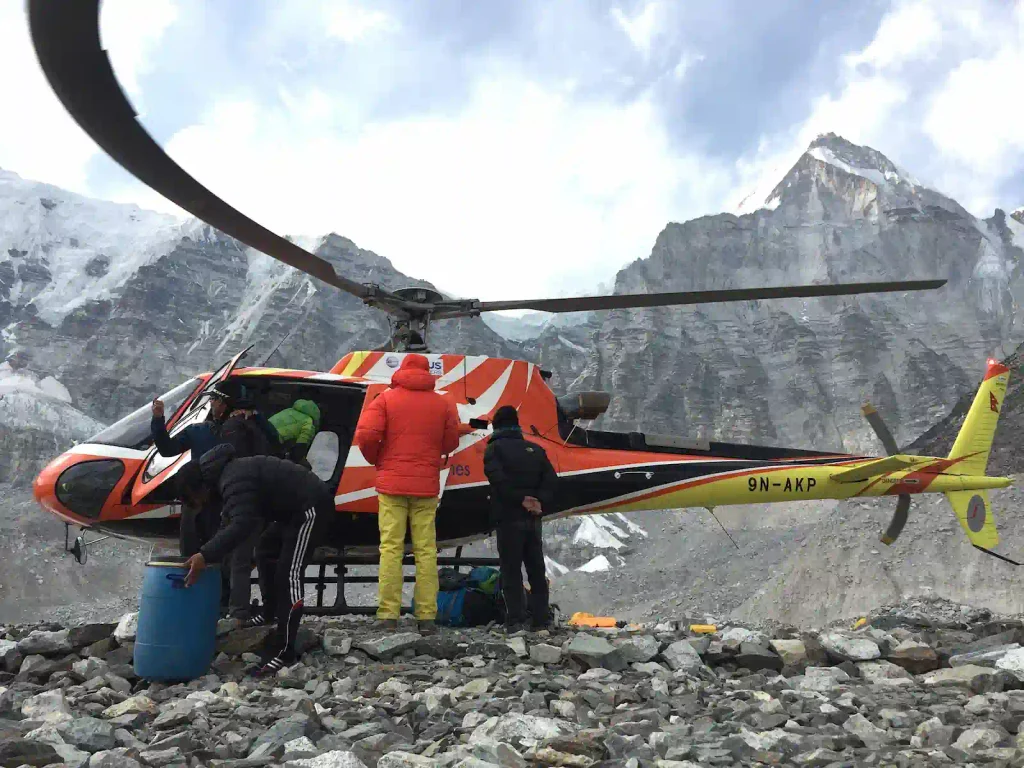
Where descent is not an option or when symptoms are severe, the most common way to obtain medical care is through helicopter evacuation. Below is a real-world description of the process, as it normally happens in Nepal’s trekking areas:
- Evaluation. Your guide evaluates your oxygen levels and other symptoms (he should have a pulse oximeter), and he decides on the spot, not through a consensus.
- The two simultaneous phone calls are made – one to the helicopter rescue coordination service and to the helicopter company itself with details about where you are, your state, and insurance information.
- Insurance validation. In virtually all situations, the helicopters will need confirmation that you have either paid the fee yourself or have valid insurance pre-authorization.
- Weather and daylight check. In the mountain region of Nepal, helicopters fly visually, not instrumentally, and almost never at night. Weather conditions are typically more favorable in the mornings; the afternoons have more cloud formation and turbulence. In case of weather-induced delays, the plan would be to evacuate by land, by foot or stretcher-porter, or even horseback, while still descending.
- Landing and picking up the patient. The helicopter lands on the helipad, in an open field, or on any other stable ground depending on the terrain conditions. Patients may have to be moved 15-30 minutes to reach a proper landing site.
- Transferring to hospital. Hospitals for treatment of altitude-related sicknesses are located in Kathmandu and Pokhara.
Total time from the decision to summon assistance to reaching hospital may vary between 1-6 hours depending on the weather conditions; in case of bad weather it might take a whole day or more.
A straight answer on evacuation trust
It’s worth addressing directly, because it’s a genuine and reasonable concern: Nepal’s trekking industry has a documented history of some operators pushing unnecessary helicopter evacuations for commission, billing insurers for rides that weren’t medically needed. It’s been reported on by international outlets and taken seriously enough that authorities and insurers have pushed for reform.
The practical takeaway isn’t to distrust evacuation recommendations in general, legitimate rescues are common and genuinely lifesaving. It’s to reduce the incentive for abuse in the first place by trekking with an agency whose guides are paid a proper fixed salary rather than working on evacuation commission. Guides with no financial stake in the decision have no reason to call for a helicopter you don’t need and every reason to call one you do.
Travel Insurance: What Your Policy Must Cover
Costs generally run USD $3,000–$10,000 depending on distance and altitude, which is exactly why insurance with explicit helicopter evacuation coverage, valid to your route’s maximum altitude, isn’t optional. A policy that caps coverage at 3,000–4,000m is effectively useless on a trek that goes to 5,000m or higher.
A few specifics worth checking before you book:
- Altitude limit: your policy should explicitly cover trekking and evacuation up to at least your route’s maximum elevation, EBC and Manaslu need cover to 6,000m, not the generic 4,000m many standard policies default to.
- Evacuation coverage amount: look for at least $100,000 in emergency medical and evacuation coverage; some budget policies cap payouts well below what a complex high-altitude rescue actually costs.
- Agency and permit policy: as of 2026, valid trekking insurance is a mandatory condition for permits in restricted areas, including Manaslu, Upper Mustang, Tsum Valley, and Nar Phu. No valid policy means no permit, regardless of route.
- Emergency contact number: carry your insurer’s 24-hour emergency line with you on the trail, not just saved at home.
Essential Tips for Trekkers in Nepal
A quick recap in case you’re skimming:
- Ascend no more than 300–500m of sleeping altitude per day above 3,000m
- Take a full rest/acclimatization day roughly every 1,000m
- Drink 3–4 liters of water daily; skip alcohol and sleeping pills at altitude
- Treat any headache at altitude as AMS until it proves otherwise
- Report symptoms to your guide immediately — never push through in silence
- Choose a route matched to your experience level, not just your bucket list
- If your route includes jeep/road access to altitude, add extra acclimatization days to compensate
- Confirm your travel insurance covers helicopter evacuation up to your route’s maximum elevation
- Trek with guides paid a fixed salary, not evacuation commission
Conclusion
Acute mountain sickness is not uncommon, it’s easy to understand, and, in most cases, completely preventable if you take things easy, stay hydrated, and be honest about how you’re feeling. However, it becomes dangerous when people don’t take their symptoms seriously or hide them from others. There’s one key thing that will help you the most to avoid AMS during your trek in Nepal, and it’s not an item you carry or a drug you need, it’s an itinerary with enough acclimatization days included and a knowledgeable guide. which is what outdoorhimalayn trek team has been doing for a long time with experience since 2004.
FAQ
Can you die from altitude sickness on the Everest Base Camp trek?
Yes, in rare cases, almost always when HAPE or HACE symptoms were ignored and descent was delayed. With a properly paced itinerary, an experienced guide, and honest symptom reporting, serious outcomes are uncommon.
Does being physically fit protect you from altitude sickness?
No. Fitness doesn’t change how quickly your body acclimatizes to thinner air, and very fit trekkers sometimes ascend faster than their body can adjust, which can actually raise their risk.
How common is altitude sickness on the EBC trek?
Mild AMS symptoms are common above 3,500–4,000m and affect a significant share of trekkers to some degree. Severe cases (HAPE/HACE) are far less common, particularly on well-paced itineraries.
Can children get altitude sickness?
Yes, the same way adults do. Children have successfully completed treks to EBC and similar altitudes, but may not communicate early symptoms as clearly, so extra attentiveness from parents and guides is warranted.
Is Diamox necessary for the Everest Base Camp trek? Not necessarily ,many trekkers complete EBC without it using a well-paced itinerary alone. Some choose to use it preventively after discussing it with a doctor. It’s a supplement to slow ascent, not a replacement for it.
Can Diamox cause problems if I have other health conditions, like glaucoma or low blood pressure?
Possibly this is exactly the kind of thing to raise with your doctor before your trip, not figure out on the trail. Diamox is a sulfonamide-based medication, so anyone with a sulfa allergy needs medical guidance before using it, and people with glaucoma, kidney or liver conditions, or blood pressure issues should get personalized advice rather than relying on general guidance like this article. Bring your specific health history to that conversation.
Will travel insurance cover altitude sickness if I have a pre-existing condition? It depends entirely on your policy and how your insurer defines “pre-existing.” Some policies exclude complications connected to a disclosed condition unless you’ve paid for specific pre-existing-condition cover; others treat altitude sickness as a standard risk regardless. Don’t assume either way, call your insurer directly, describe your trek’s maximum altitude, and get their answer in writing before you go.
Do Sherpas and other high-altitude populations have a genetic advantage against altitude sickness?
Yes, this is well-documented. Populations with generations of history living at high altitude, including Sherpas and Tibetans, have documented genetic adaptations that help their bodies use oxygen more efficiently at elevation. It’s part of why experienced Sherpa guides often move through altitude that leaves visiting trekkers breathless, it’s not just training, it’s genuine physiological adaptation built over generations.
Updated On: 23 Aug 2026